
 CategoriesHot Products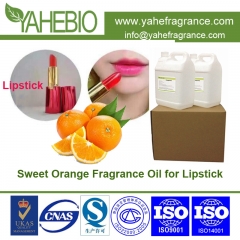
Food grade; Pure and Nature sweet orange flavor profile; Hight quality and favorable factory price. Dosage for lipstick: 0.5-3%.
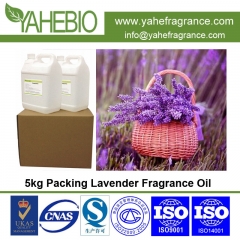
Long lasting; 16 years manufacturer of flavor and fragrance with ISO9001, ISO14001, ISO22000 Certificates; Pure and natural lavender profile; Hight quality and favorable factory price. Dosage for laundry: 0.2-0.5%
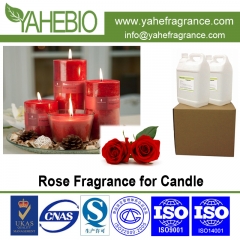
Natural and pure rose aroma, special used in candle application
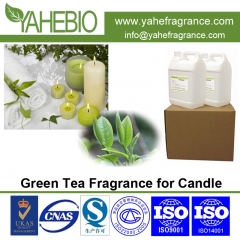
Strong green tea aroma profile, used in candle application.
tagsYou're standing before a wall of bottles, completely overwhelmed by the endless options. How do you choose fragrance oils for your diffuser? The answer starts with a clear purpose. I once blended five different scents at once—the result was a clashing mess that filled my kitchen with something resembling burnt candy. That failure taught me the professional approach. Selecting the right oil begins with matching your goal to the right essential oils. Ask yourself what mood you want to create. Your perfect blends emerge from this experience of trial and error. Trust your nose, start simple, and build confidence with each attempt. Let's find your perfect blend.
Start with a clear goal for your room's mood to guide your oil choices.
Learn the four scent families and use the 30/50/20 rule for balanced blends.
Test small batches and keep notes to refine your custom blends.
Choose high-quality, IFRA-certified oils to protect your diffuser and health.
Avoid overcomplicating blends; start simple and trust your nose.
Before you pick a single bottle, pause. Ask yourself one simple question: "What do I want this room to feel like?" That question is your compass. It guides every decision. The goal of your blend—relaxation, energy, focus, or ambiance—determines which diffuser fragrance oils you choose. When you start with a clear purpose, you build a blend that works. Let's look at how to choose fragrance oils that match your goal.
Your mood sets the direction. Want to unwind? Look for relaxing scents. Studies show lavender increases alpha and theta brain waves. This creates deep relaxation. It also interacts with GABA receptors, the same pathway used by anti-anxiety medications. The fragrance of lavender is soft and floral. Citrus oils like lemon, sweet orange, and bergamot work differently. They reduce anxiety and boost positive affect. They increase serotonin activity. That makes them perfect for lifting your spirits without making you drowsy.
Need energy? If you need energy, peppermint is essential. It enhances memory and increases subjective alertness. The fragrance of peppermint is sharp and invigorating. Rosemary has a similar effect. Its active compound, 1,8-cineole, correlates with better cognitive performance. Ylang-ylang offers a middle ground. It increases calmness, though it may slow your reaction time. By matching the scent to your desired mood, you create a targeted aromatherapy experience.
The time of day matters just as much as your mood. Morning diffusion calls for bright, zesty aromas. Lemon, peppermint, and eucalyptus are fantastic for getting you going. They promote focus and alertness. Evening relaxation needs softer profiles. Lavender is a classic choice. Chamomile creates an atmosphere of pure peace. Bergamot offers uplifting calm, while sandalwood provides deep grounding.
The room itself also plays a role. Consider choosing scents room by room. A kitchen might handle herbal or citrus notes well. A bedroom calls for florals and woods. Think about matching scents to season, too. Light, fresh scents work well in summer. Warm, spicy notes feel right in winter. When you consider the space and time, you refine your essential oil blends even further.
Every fragrance oil belongs to a family. Think of these families as personality types for scents. Once you recognize them, you can predict how different oils will behave together. This knowledge transforms guesswork into skill.
Four main families cover most diffuser oils you will encounter. Floral scents feel romantic and soft. Rose and jasmine lead this group. They suit daytime spaces or springtime moods. Woody oils bring earthy sophistication. Sandalwood and cedarwood anchor this family. They work well for autumn evenings or professional settings. Oriental fragrances feel warm and sensual. Vanilla and amber define this category. They shine during winter nights. Fresh oils deliver clean, energizing aromas. Citrus and marine notes stand out here. These scents fit summer days perfectly.
Each family carries its own character. A floral oil might contain hints of citrus. A woody blend could include subtle florals. The dominant impression determines the family, not the supporting notes. This clarity helps you choose oils that match your intended mood.
Professional perfumers think in three layers. Top notes evaporate fastest, lasting about 5–20 minutes. They create the first impression. Middle notes linger for 2–6 hours. They form the heart of your blend. Base notes persist for 12–48 hours or longer. They ground everything else.
|
Note Type |
Evaporation Rate |
|---|---|
|
Top |
5–20 minutes |
|
Middle |
2–6 hours |
|
Base |
12–48 hours or longer |
The 30/50/20 rule offers a simple starting point. Use 30% top notes, 50% middle notes, and 20% base notes. This ratio creates balanced essential oil blends that evolve beautifully over time.
Base notes typically make up between 5% and 20% of a blend. A little goes a long way in providing lasting depth.
Start with single scents before attempting complex combinations. Lavender and orange pair well together. Lavender acts as the middle note; orange provides the bright top note. For something deeper, try cedar wood, ginger, and juniper berry. Cedar wood forms the base, ginger adds sparkle as a top note, and juniper berry fills the middle.
Base notes deserve special attention. They determine how long your blend lasts. Choose long lasting diffuser fragrance oils with strong base notes for extended enjoyment. These oils anchor your creation and prevent it from fading quickly. Experiment with unexpected pairings. Trust your nose. Each attempt teaches you something new about how scents interact.
Now you understand scent families and note layers. It's time to put that knowledge into action. The 30/50/20 rule gives you a simple framework for building balanced custom combinations. You allocate 30% of your drops to top notes, 50% to middle notes, and 20% to base notes. This ratio creates a fragrance that evolves beautifully over time. The top notes hit you first, then the middle notes emerge, and finally the base notes anchor the entire experience. This structure prevents any single scent from dominating.
Start with a 10-drop batch. That small size lets you test different scents without wasting expensive oils. For 10-drop blends, you need 3 drops of top note, 5 drops of middle note, and 2 drops of base note. Here is the breakdown:
|
Note Type |
Drops for 10-drop batch |
|---|---|
|
Top |
3 |
|
Middle |
5 |
|
Base |
2 |
Each drop measures roughly 0.05 mL, so 10 drops equals about 0.5 mL of total oil. This tiny batch is perfect for learning. You can try pairings like a fresh citrus top with a woody base. Guided sniff tests help you personalize the blend. Smell the essential oils separately, then combine them on a test strip. Adjust ratios until the fragrance feels right. For example, you might increase the base note to 3 drops if you want a longer-lasting scent.
Testing is where custom-made blends come to life. Follow these steps for reliable results:
Test and Note – Write down the blend details including date, composition (e.g., 3 Orange + 5 Lavender + 2 Frankincense), room, result, and next change.
Start simple – Begin with a 2-oil blend like Orange and Lavender. Add a base note on Day 3.
Adjust drop count – Consider room size. Start low and increase only if needed.
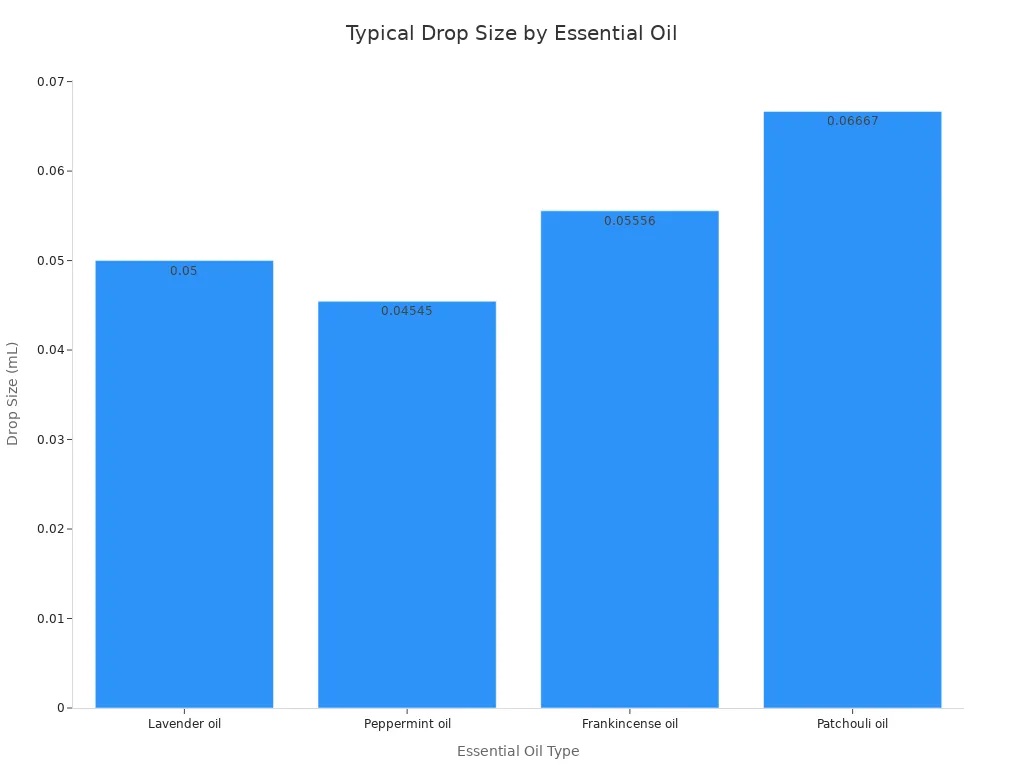
Record your results in a small notebook. Track what works and what doesn't. Change one thing at a time. This essential approach helps you refine your creations systematically. You'll discover which notes pair well and which ones clash. Maybe you find that a certain citrus top note fades too fast. You can then increase its proportion or switch to a different oil. Over time, you build confidence and create signature diffuser blends that match your space perfectly. The key is to experiment with blends and keep notes on every attempt.
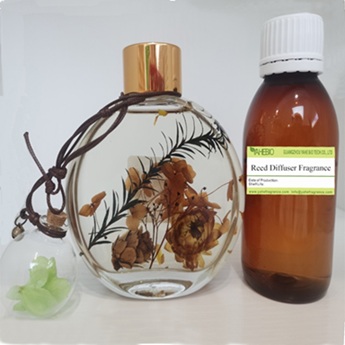
Understanding the difference between these two categories shapes every purchasing decision you'll make. Essential oils come from plants—seeds, flowers, leaves, roots, stems, or bark—through steam distillation, expression, or extraction. They contain only natural plant compounds. Fragrance oils, by contrast, combine essential oils with synthetic aroma chemicals, deliberately crafted to produce specific scents for consumer products.
|
Aspect |
Essential Oils |
Fragrance Oils |
|---|---|---|
|
Source |
100% pure plant extracts |
Typically synthetic or partially natural |
|
Composition |
Pure plant compounds only |
Carrier oils mixed with synthetic or natural fragrance oils, often including preservatives |
|
Health Effects |
Natural aromas with potential therapeutic benefits |
May cause skin irritation or allergic reactions with prolonged exposure |
Both types work perfectly well in diffusers. Your choice depends on your priorities. If you want aromatherapy benefits, the right essential oils deliver natural chemical complexity. If you're chasing a specific scent profile—say, a dupe of a luxury perfume—a quality fragrance oil for diffuser use gives you that precision. Many enthusiasts keep both on hand.
So how to judge fragrance oil quality before you commit your money? Start with certifications. IFRA (International Fragrance Association) has set global standards for fragrance safety since 1973. An IFRA certificate tells you the oil meets safety limits for human health and environmental impact. Each compliant product specifies the maximum usage percentage for different categories, including diffusers. This certification serves as a recognized benchmark for quality, safety, and consistency.
Purity matters equally. High-quality oils should list their ingredients transparently. You want to know exactly what you're diffusing into your air. Reputable suppliers provide this information readily. Yahe Bio, for instance, offers diffuser-safe fragrance oils with clear sourcing documentation and IFRA compliance—exactly the kind of transparency you should demand from any vendor.
Shelf life also reveals quality. Citrus oils like lemon and orange last 1–2 years. Herbal oils such as eucalyptus and tea tree remain potent for 2–3 years. Woody oils like sandalwood can last 4–6 years. Professionally formulated diffuser fragrance oils are designed for greater stability over time, though their longevity varies by formulation. If an oil smells off or looks cloudy before its expected lifespan, that signals poor manufacturing.
Dilution matters for safety, too. For body care products, essential oil content should stay between 0.5% and 2% of the total blend—roughly 3 to 12 drops per ounce of carrier oil. Diffusion uses even lower concentrations since you're dispersing into air rather than applying to skin.
Low-quality oils create real problems. Poorly manufactured products can clog or corrode your diffuser's ultrasonic plate. Synthetic additives may release irritants when heated. You might save money upfront, but you'll pay for repairs or health issues later. Investing in high-quality oils protects both your equipment and your well-being.
Your nose knows quality. Premium oils smell complex and layered, never harsh or chemical. They evolve beautifully in your essential oil blends. They perform consistently batch after batch. When you find a supplier who delivers that experience, stick with them. Your diffuser—and your senses—will thank you.
Even experienced blenders fall into traps. Knowing what to avoid saves you time, money, and frustration. Here are the two most common pitfalls.
The biggest mistake? Adding too many ingredients at once. You want complexity, but more isn't better. Start with two complementary scents. Clashing fragrance families create "perfume white noise" where individual notes get lost. Pairing heavy orientals with fresh aquatics rarely works. Their profiles are too different. Stick to adjacent families on the fragrance wheel. Pair woody with spicy, fresh with citrus, or floral with gourmand.
Over-applying is another trap. You can always add more oil, but too much creates an overwhelming, clashing profile. Start conservatively. Use 3–4 drops total for a small batch. Follow the 30/50/20 rule. Pay attention to concentration levels too. Different concentrations evaporate at different rates. Apply the strongest concentration first as a base. Layer lighter formulations on top. This preserves delicate notes and prevents them from fading too fast.
Low-quality oils cause real problems. They clog your diffuser faster. Residue builds up in hard-to-reach areas. You get weaker scent throw and inconsistent mist output. The device makes gurgling noises. Its motor lifespan shortens. Over time, you damage the equipment. That's why quality matters. You want long lasting diffuser fragrance oils that perform well. But quality isn't just about performance. It's about safety.
Safety considerations matter too. Check the flashpoint before use. The Safety Data Sheet (SDS) is the authoritative source for this information. It tells you about flammability risk during heating. Allergy risks are real. The FDA acknowledges that some people are allergic to fragrance ingredients. Do a patch test on your inner forearm. Observe for 24 hours. If you have pets, children, pregnant individuals, or anyone with asthma or migraines, extra caution is needed. Use ventilation and shorter scent sessions. Also, ultrasonic diffusers aren't suitable for concentrated blends. Reed diffusers and room sprays need specific bases. Using the wrong device causes damage or uneven exposure.
Investing in high-quality oils protects both your diffuser and your health. With essential oils, you want purity and transparency from your supplier. The cheap bottle saves you a few dollars today but costs you a new diffuser tomorrow.
You now know how to choose fragrance oils with confidence. Define your mood first, explore scent families, and apply the 30/50/20 rule. Prioritize quality oils that protect your diffuser. Avoid overcomplicating your blends.
This journey has no wrong answers. Every attempt teaches you something new about scents. Start simple with lavender and orange. Build from there.
Trust your nose. Experiment freely. Your signature blends will emerge with practice. Brands like Yahe Bio make finding trustworthy diffuser fragrance oils easier, but your creativity matters most.
Now you have the tools to create essential oil blends that feel like you. Share your favorite custom combinations in the comments below!
Start with 3–5 drops per 100 mL of water. You can always add more, but removing excess is impossible. Small batches let you test without wasting your oils. Adjust based on room size and your sensitivity to strong scents.
Yes, you can use candle fragrance oils in a diffuser, provided they're diffuser-safe. Check the label for IFRA certification and suitability. Some candle oils contain carriers that may clog ultrasonic diffusers. When in doubt, choose a product explicitly labeled for diffusion.
Focus on base notes. Woody oils like sandalwood and cedarwood anchor your blend and extend its life. Follow the 30/50/20 rule with a solid base percentage. You'll get long lasting diffuser fragrance oils that evolve beautifully over several hours.
Essential oils come from pure plant extracts. Fragrance oils blend synthetic and natural aroma chemicals. Both work in diffusers. Choose the right essential oils for aromatherapy benefits. Pick fragrance oil for diffuser use when you want precise scent profiles like luxury perfume dupes.
Look for IFRA certification and transparent ingredient lists. Reputable suppliers like Yahe Bio provide clear sourcing documentation. Trust your nose—premium oils smell complex and layered, never harsh or chemical. Quality oils protect your diffuser and your health.







 ONLINE
 13923210784
